Tales of the Sausage Factory:
SkyAngel Files Program Access Complaint — Has Media Bureau Really Changed, Or Will They Again Sit On Sidelines?

Some people wonder why I remain so down on the Media Bureau. “Harold,” they say. “Why do you keep saying the Media Bureau are in the pocket of the cable industry? Aren’t they just all fired up and rarin’ to go on the upcoming cable set top box proceedings?”

Perhaps I am allowing the experiences of the past to cloud my vision of a hopeful tomorrow. Perhaps, despite an utterly abysmal track record on cable matters, the cable folks in the Media Bureau have now turned over a new leaf. Perhaps now they will at least process complaints in less than three years, so that companies other than cable operators might feel they get some due process — if not actual justice — at the FCC. Who knows?

Which is why I shall watch the developments around the Sky Angel program access complaint with considerable interest. Sky Angel used to distribute programming by satellite, making it eligible for the “program access” rules that require cable operators with affiliated programming to make that programming available to rivals. (I’ve written about these rules at length before here.)

From what I can tell from the limited data available, Sky Angel is now a “Christian IPTV distributor.” It resembles a cable/satellite-like service (or “MVPD” for “multichannel video programming distributor”) in every way except for the fact that it does not own its own facilities. It distributes its programming online. We generally call these things “over the top” video distributors. According to the Broadcasting and Cable story (since I haven’t been able to find a copy of the complaint), the Discovery Channel has decided to terminate its distribution contract with Sky Angel four years early — apparently because Sky Angel has switched its distribution model to become a pure over-the-top distributor.

My problem is, that this looks very similar to a complaint a company called VDC (“Virtual Digital Cable”) filed three years ago. The Media Bureau has yet to process that complaint, but there’s no rush — since the company went bankrupt and shut down while waiting for Media Bureau action.

More below . . . .

Continue reading

Inventing the Future:
In the End

There’s a lot of thunder about Apple’s new developer licensing, in which programmers are required to use one of three members of the “C” family of programming languages. iPhones (and soon iPads) really do matter, so people are sensitive to anyone controlling or wrecking the process by which apps get created. The prevention of developers from using their languages of choice is inflaming an “Apple hates its developers” conception.

I think people are confusing implementation with design.

Continue reading

Tales of the Sausage Factory:
The Comedy of Comcast v. FCC Part I — What Did The Court Actually Do?

It’s been rather busy the last few weeks. Between my unfairly holding Sprint responsible for its own screw ups, shamelessly cheering on the documentation of our national broadband drought by Our Great Google Overlords, and generally crushing all who dare oppose me, it’s been hard to find time to blog about stuff. So naturally, while I was away for the last day of Passover, the DC Circuit issued its long awaited decision in the Comcast/BitTorrent case, Comcast v. FCC.

Needless to say, the opinion was greeted with the total hysteria that has become the hallmark of the network neutrality debate — with terms like “Nuclear Option,” “World War III,” and “spanking.” Opponents of FCC jurisdiction rejoiced, supporters of network neutrality lamented, and a few shrewd observers noted that the actual outcomes could prove far worse for Comcast and the incumbents than if Comcast had lost (as I noted after oral argument last January).

My co-counsel, Marvin Ammori, has written up his retrospective here. Understandably, he’s rather bummed. Despite this whole thing being my idea in the first place, however, I’m actually rather pleased and amused with how this whole thing is turning out. Sure, I would much rather have won. But as the history of the last 2+ years of this unfolds, the tale of how Comcast managed to bluff, badger, and bungle itself into a position where it has not only guaranteed harsher condition on its merger with NBC-Universal, but revived the possibility of classifying broadband access as a Title II telecom service for the first time in 10 years, is the stuff of high farce. And while I wish I could claim credit for this outcome, the real “heroes” here are Brian Roberts (head of Comcast) followed closely by AT&T, NCTA and the Republican party.

To try to keep this manageable, I’ll divide this into two posts. Below, I will try to set forth what the court actually said and the immediate legal implications, without worrying too much about the overall policy. While I can hardly claim to be an impartial observer, I’ll do my best to identify my editorial comments as such and note where reasonable minds can differ. In Part II, I shall shamelessly indulge myself with my own eyewitness to history and why I think the Comedy of Comcast v. FCC deserves its special place in the realm of farce — although we have by no means reached a certain conclusion.

More below . . .

Continue reading

Neutrino:
Revision Control

I’ve had a blog post percolating in my head for a while. It hasn’t quite taken form yet, but meanwhile it’s been gathering related ideas like iron filings to a magnet. So here’s a companion piece to the post I haven’t written.

Agent Nathan Bransford wrote a humorous take this week on the maxim that “writing is rewriting,” which reminded me of a story that anyone who reads my writing should hear at least once:

In math class, my sophomore year of high school, we sometimes did proofs. Putting axioms in the hands of adolescents can be a dangerous thing. Give them a few equations and the transitive property, and there’s no telling where they’ll end up. Whenever a student was called to the board to share his solution to a problem, and reached Q.E.D. but kept going anyway, our teacher would interrupt and say, “Stop right there. You’re fingerpainting.”

He wasn’t ridiculing anyone but himself.

Continue reading

My Thoughts Exactly:
Thoughts on the movie “Sideways” — What if Miles had self-published?

Hey, remember that film Sideways? A few years ago it got a lot of notice & won some Academy Awards & gave a big boost to Paul Giamatti’s career. I went to see Sideways with my wife when it came out, and boy, did it steam her up. I have never seen a movie make her so angry. She would barely talk to me when we left the theatre, and I had nothing to do with the movie! All I did was suggest we go see it, based on some reviews I had read that called it a “buddy movie/road movie” and a “comedy/drama” about two middle-aged guys depressed with their lots in life who go off to the wine country the week before one of the guys is to be married. From my wife’s reaction, you would think I had tricked her into going with me to some sleazy sex club for some “spontaneous” fill-in-the-blank.

Below the fold: The difference between moving sideways and taking the slow train to hell.

Continue reading

My Thoughts Exactly:
Smashwords, iPad, Doctorow, Zeldman: further bumbling self-publishing adventures

Over on the Self-Publishing Review, my Adventures in Self-Publishing is still front-paged and generating some nice contact, public & private. Go me! But I’m still not rich yet. So anyway(s), as discussed, I’ve signed up with Smashwords to distribute my Acts of the Apostles. It’s been accepted into the iPad store, for which iPad-hater Cory Doctorow would give me a “boo-bad” and iPad hater-hater Jeffrey Zeldman a “way-to-go”, I expect. DOCTOROW-ZELDMAN STEEL CAGE DEATH MATCH! Or not. So long as they both keep saying nice things about my books it’s all good, as the surfers say.

So far, my Smashwords results not all that impressive: 82 downloads and zero sales.

On the other hand, the book is only available on Smashwords so far, not on Amazon or iPad. Maybe best-sellerdom is right around the corner!

Further reflections on Smashwords, iPad, OpenLaszlo, self-publishing, etc, etc, below the fold.


Continue reading

My Thoughts Exactly:
A real-live (OK, real-mechanical) Turing Machine, and a real-live Hoosier locution.

For any of y’all sufficiently ungeekoid so as to not understand why this machine is only the coolest thing in the history of fuckall, first, Welcome to Wetmachine, and how the frack did you end up here? And second, please see this very helpful wikipedia article, which will get you up to speed.

As a special, special, bonus, right about the 4-minute mark into this video the narrator/machine-maker uses a locution (is there a name for it? pls ans) in which the words “to be” are omitted from the object-verb of the verb “to need”, and the naked past participle is used instead, viz, Each loop of the Turing program reads the current cell and uses the transition rules to determine if that cell needs changed. N.B. “needs changed”, not “needs *to be* changed”. About this idiomatic usage, Wiktionary says:

Rarely, with a past participle, as in “Something needs done”, which is synonymous with “Something needs to be done.” Note that many speakers do not find this construction to be acceptable.

Please note that *this* speaker, me, finds this construction perfectly acceptable. My Dear Wife, a native of Evansville, Indiana, uses it, and finds herself unable to change that habit after 30 years of effort to speak more “correctly” since I first pointed it out to her. I just think it’s charming when she speaks Southern-Indiana-style and will be heartbroken if she ever drops this usage.

But I doubt she will. After all, according to this source referenced by Wikipedia,

“ (If you’re a need/want+Ved speaker — ”The garden needs watered“ — you can go for decades without realizing that lots of other people don’t use this construction, ever.)”.

But I’ll bet Alan Turing would have noticed. That guy didn’t miss much. (I nearly said “That guy didn’t miss a trick”, but that would have opened a whole nother can ‘o worms.)

Neutrino:
Proficiently Enhanced

When John asked me to write here, I was tempted mainly for two reasons. The first was that I had a lot of ideas tumbling around my head about the publishing industry, the software industry, and the ways in which they are both alike and different. When I have something in my head, my natural impulse is to write it down. I was contemplating hanging out my own shingle on the World Wide Web. But while I was planning my own perfect site, John offered a spot at Wetmachine, and it struck me that this was a place that was already well suited for sharing these writings.

We are certainly living in interesting times, when publishers are grappling with tectonic shifts in technology and culture, while creators are exploring new ways of reaching audiences. “They” have been saying that media is dying for longer than I can remember, but to me that sounds like a meaningless statement. I think media is about to get bigger than ever, in almost every way imaginable, and some ways we can’t even conceive of yet. When it comes to the media of tomorrow, I believe there are going to be even more ways to discover words, images, sounds, and ideas than there are today, more ways to soak them in and have them become a part of you.

You can get a taste of this every day just by dipping your cup into the ever-churning sea of the Internet, which is the other reason I wanted to write here. There are people everywhere doing fascinating things that stretch our ideas of what art is, or what a story looks like. There are tons of smart people writing about some of the same topics that I’m preoccupied with. I wanted a place to share these discoveries as well.

Now, my goal here is not to be another conduit for memes flowing from screen to glowing screen, but writing on the Web is inherently about creating links, making connections, and spreading ideas. So sometimes I’ll use this space just to offer you a sip from my cup when I’ve found something brilliant and to say “try this — it’s awesome” but most of the time I hope to build upon what already exists out there and contribute something that is worth folding back into the mix.

I didn’t exactly plan for my first link here to be to one of my own projects. I believe it’s both interesting and germane, but I’ll let you be the judge. It’s a new science fiction magazine that I’m starting with some friends. My role is editorial director, and I wanted to give a little insight into what that means to me.

Continue reading

My Thoughts Exactly:
Nanomachines manipulating DNA– and Grigory Perleman

Yesterday on Slashdot, a link to an article about nanomachines that can target individual genes — in this case to cure cancer. A long discussion follows in the comments (500+ comments) about implications of this technology, whether it might be used for ill as well as good.

I have not yet had the heart to read many of the comments. The technology described, and the implications thereof, are, of course, are pretty much the essence of my novel Acts of the Apostles, which I began writing 15 years ago and published more than ten years ago. Every time I see life imitating (my) art like this, I confess, my inner Grigory Perleman kinda starts to make rumbling noises deep in my bosom. Perleman’s the math genius & Howard-Hughes style recluse who refuses to accept $$ millions prizes for his solution of the Poincare conjecture because he’s evidently pissed off that his genius wasn’t recognized earlier. “You are disturbing me! I am picking mushrooms,” he hollers through the door to reporters who want to ask him about his mathematics and his opinion on prizes.

I did make a comment on Slashdot posting a link to this glowing Slashdot review of Acts by Slashdot co-founder Hemos. He at least recognized my genius. The other Slashdotters have probably modded by comment into oblivion by now. Such is the fate of us geniuses.

But just for the record, if anybody wants to give me a million dollar prize for writing Acts of the Apostles, I promise you I’ll accept. In fact, I’ll be happy if you just buy a copy.

My Thoughts Exactly:
Taking a flyer

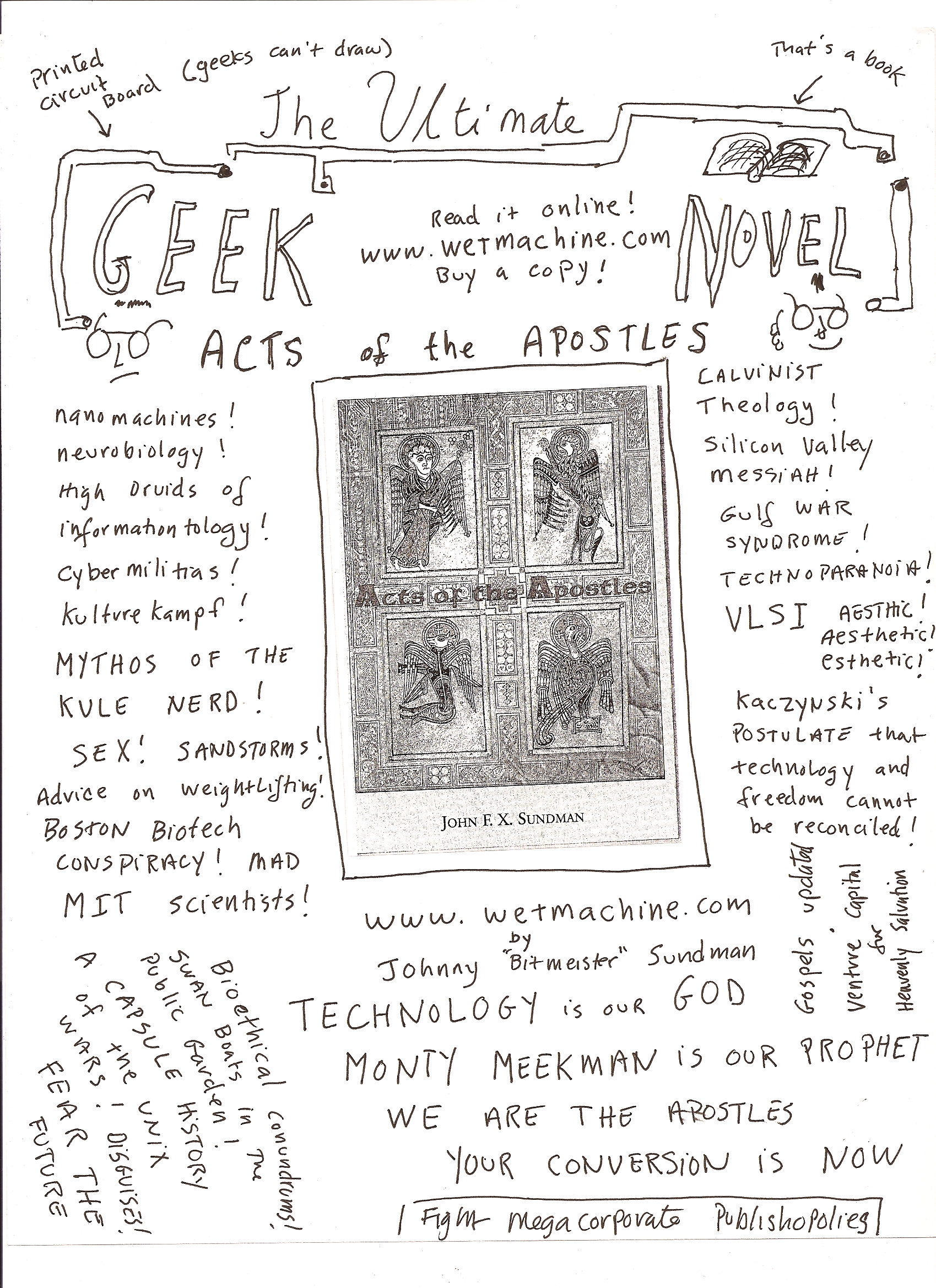
My father is among many people who use the idiom “take a flyer” to mean “take a risk”. (I know that millions of other people use the expression also, but I always hear it in my father’s voice: “Go ahead, take a flyer. Nothing ventured, nothing gained.” etc, etc). Well, I certainly took a flyer when I got laid off from the proverbial day job sixteen years ago and decided to move to Martha’s Vineyard & try to make a living as a freelance technical writer. And I took a flyer when I then took a few years to write a novel in between stints as truck driver, construction laborer, etc. And I took a flyer when I decided to self-publish. But today I’m going to talk about when I took a flyer & crafted a cheesy hand-drawn flyer as a marketing tool for my books, making me look perhaps even more of a crackpot than I actually am, if that’s possible. In some ways it was the most successful of all of these flyers.


Continue reading