Neutrino:
Two-Fisted Tales of Spam Fighting

Over the past few weeks, we’ve been flooded with spam comments—up to 100 per day.  While 100% of it is caught by WordPress’s more-or-less standard Akismet anti-spam plugin, it still ends up in a spam queue that I have to go through and clean on a daily basis.

Most blog maintainers probably just clear their spam queue and move on. Not me, though. Spammers annoy the hell out of me the same way many home owners get pissed at someone tossing beer bottles or candy wrappers into their yard. Yeah, it takes a few seconds to clean up, but the fact that you have to do so because of someone else’s assholery really gets under your skin. If I had an easy avenue to do so, I’d file complaints about these tools to the hosting services hosting the sites they are flogging. The ones I do bother tracking down are, unlike your average penis-pill and “russian girls waiting scam date you” site, seem to actually be hosted in the US or some other place that might be responsive to spam complaints. If someone is looking for a coding project for a WordPress plugin, make one that will let you send off a report of comment spam to the site’s ISP.

Anyhow, I set out to make it as hard as possible for spammers to dump their trash in our back yard. And apparently, for the moment, I seem to have won. It’s still early, but our spam queue has been clean for the last two days. Hopefully there’s no collateral damage (err… more so that there was already, see after the jump). If you see anything weird on the site, post a comment or send a message via the comment form (especially if I managed to break commenting).

How I managed my (Pyhrric?) victory after the jump.

Continue reading

Tales of the Sausage Factory:
The Community Broadband Fight In North Carolina

The problem with fighting extremely bad corporate-sponsored legislation is that it has a distressing tendency to re-emerge time and again long after a human being would have gotten a clue and gone away. So it is with the fight by corporate carriers against local governments providing any sort of broadband. Most of us thought this fight over about 5 years ago, when the majority of carriers realized that municipal networks not only were not a threat, but were potential customers. Since then, excluding the occasional flair up around projects like Lafayette’s fiber build, things have generally been quiet on this front. As a result, we have a number of useful munibroadband networks (see this map) and, surprise surprise, big carriers continue to make money hand over fist.

Alas, some big carriers never give up their big dreams of squashing all who oppose them and crushing the life out of anyone who might show them up. So it is with Time Warner Cable in North Carolina. TWC’s allies in the NC state legislature tried year after year to get legislation banning local governments from providing broadband in communities where private companies haven’t bothered or do a dreadful job. Every year, a coalition of the tech community and local governments would refight the same fight and manage to kill the bill again.

But to TWC’s great delight, Novemeber 2010 ushered in a new generation of Tea Party Republicans who intend to show their respect for localism and small town virtues by kicking the crap out local governments that try to bring broadband to the people. As a result, the North Carolina House has now passed this job-killing piece of corporate welfare designed to protect helpless providers like TWC from small towns and rural areas they don’t want to serve. An equally awful version now seems ready to pass in the North Carolina Senate.

A bit more detail, and how we can do our part to save municipal broadband below . . . .

Continue reading

My Thoughts Exactly:
Heinäsirkka, heinäsirkka, mene täältä hiiteen — an economical reposting

I don’t think I can say it any better than I did last year, so without further ado, our best Wetmechanical salute to brave St. Urho, who drove the grasshoppers from Finland, the land of my (some of) my fathers. And mothers.

Grasshopper, Grasshopper, buzz off why don’t ya?

That special time of year, when St. Urhu’s day elides into the name-day of St. Padraic, is again upon us. Longtime readers know that here at Wetmachine we have a special place in our hearts for this great Finno-Irish-American festival–mainly on account of I started this site and I’m a Finno-Irish American, of which there ain’t too damn many offer dere, as my late Grandfather “Pop” used to say.

Ode to Saint Urho

Ooksie kooksi coolama vee – Santia Urho is ta poy for me!

He sase out ta hoppers as pig as pirds – Neffer peefor haff I hurd tose words!

He reely tolt tose pugs of kreen – Braffest Finn I effer seen!

Some celebrate for St. Pat unt hiss nakes – Putt Urho poyka kot what it takes.

He kot tall and trong from feelia sour – Unt ate kala moyakka effery hour.

Tat’s why tat kuy could sase toes peetles – What krew as thick as chack bine neetles.

So let’s give a cheer in hower pest vay – On Sixteenth March, St. Urho’s Tay!

P.S. The Irish, sure, will take care o’ temselves on the morrow; of that I’ve do doubt.

Neutrino:
The Seventh Rule — Chapter 7

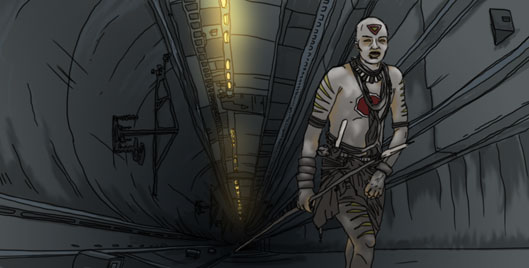
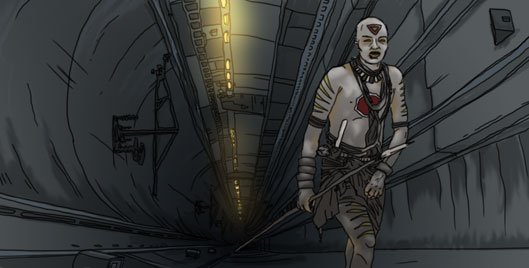
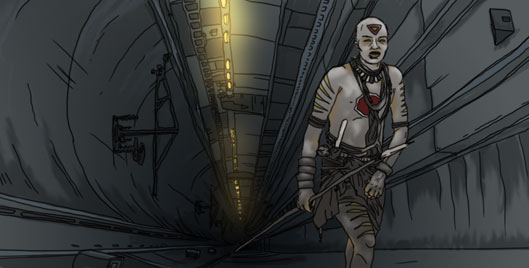
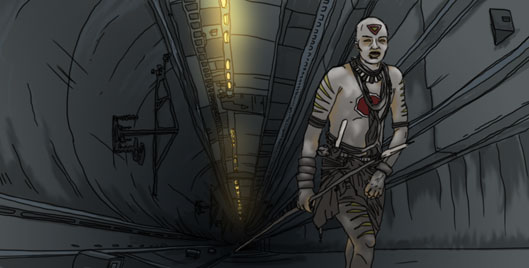
And now the concluding chapter of The Seventh Rule, another free science-fiction serial from the likes of me. The complete story is available in print in my latest anthology, Eleven Electric Lies, which you might buy a copy of and then bring along for signing at the Toronto Comic Con! I hope to see you (or a duly appointed representative) there, March 18-20, 2011.

The Seventh Rule, illustration by the author
Continue reading

Inventing the Future:
Controlling Time: TeaTime

Previous: Dial-tone for Cyberspace

Many of us remember where we were when we saw some seminal event unfold on TV. We may have been doing different things, but we shared a common experience through the live broadcast. Parts of each person’s experience were not shared. The shared experience is the part that came off the screen and out the speakers. Continue reading

Inventing the Future:
Controlling Time: The Dial-tone for Cyberspace


Previous: Weapons of Math Destruction

Imagine we are at the Nasa Operations center, and it is filled with people attending to different aspects of a space launch. The operations director checks in with the different domain specialists: “Communications?” “Go.” “Environment?” “Go.” “Transport?” “Negative! We have a problem.”  Within that room, the specialists are focused on the complex applications and information in front of them. They all need to hear and speak to each other, and to see some common data on the big board at the front of the room.  As the situation changes, some of the problematic applications are examined by related specialists who were not looking at it previously.

Now imagine a distributed virtual operations center.

Continue reading